News
Broadwell Air Dome
 Site
/uploads/image/677267645dfcf.png
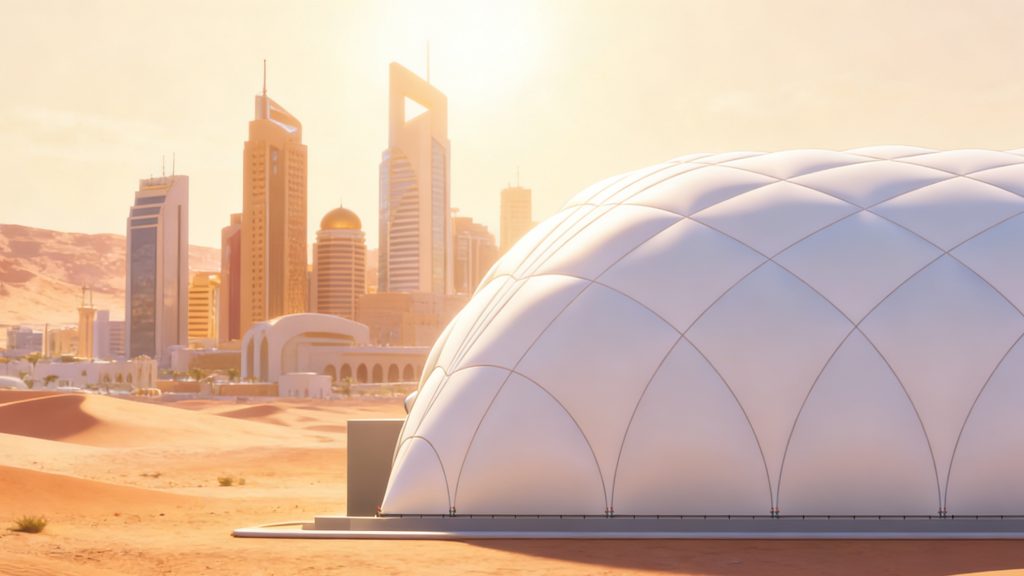
In the intense heat of the Middle East, how can air domes create a comfortable environment while being energy-efficient? This discussion looks at the importance of choosing the right materials, using effective insulation, and optimizing air conditioning systems to keep indoor temperatures between 24–26°C while significantly reducing energy costs. By focusing on high solar reflectance and thermal emittance, Broadwell Air Dome offers a complete solution for sustainable cooling in challenging climates.
Site
/uploads/image/677267645dfcf.png
In the intense heat of the Middle East, how can air domes create a comfortable environment while being energy-efficient? This discussion looks at the importance of choosing the right materials, using effective insulation, and optimizing air conditioning systems to keep indoor temperatures between 24–26°C while significantly reducing energy costs. By focusing on high solar reflectance and thermal emittance, Broadwell Air Dome offers a complete solution for sustainable cooling in challenging climates.
Air Dome 101 | Maximizing Comfort and Energy Savings in Air Domes: Broadwell's Solutions for the Middle East
Views: 1482
Author: Broadwell Air Dome
Publish Time: 2025-12-29
Origin: Site
In the blistering heat of the Middle East, how can air domes provide a comfortable environment while also being energy-efficient?
The region endures extreme temperatures year-round, with summer highs often exceeding 50°C. To maintain indoor temperatures within the comfortable range of 24–26°C, traditional solutions often require air conditioning to operate at full capacity for extended periods, resulting in high energy costs. To create a balance between comfort and energy conservation, air domes must focus on precise control throughout the entire process—from materials, equipment, to design.
Material Selection: Preventing Heat Invasion and Accumulation
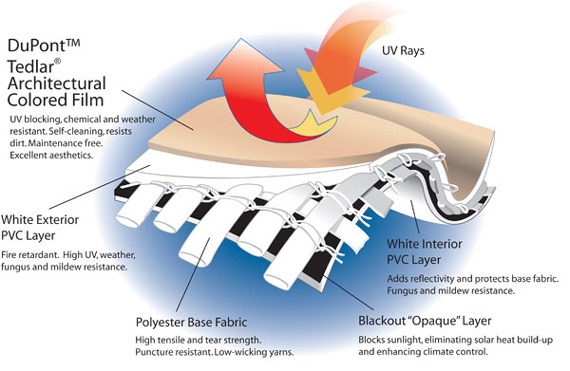
The thermal insulation performance of air domes fundamentally relies on the membrane material itself. Broadwell Air Dome has developed a specialized membrane solution tailored for the high temperatures of the Middle East, optimizing everything from color selection to core parameters.
1. Membrane Material Selection: Maximizing Sunlight Reflection
Choosing the right membrane color is vital for managing the intense sunlight in the Middle East. Broadwell Air Dome prioritizes white membrane materials, which offer high reflectivity and low absorption of sunlight. It effectively reduces solar radiation heat entering the interior, lowering the cooling load from the outset. In contrast, some competitors still use gray membrane materials, which absorb more heat and provide significantly inferior insulation.
2. High Solar Reflectance (SR): Enhancing Heat Reflection
Solar reflectance (SR) is a critical indicator of a material's insulation capability, measuring its ability to reflect solar radiation (visible light plus near-infrared light). The SR value ranges from 0 to 1 (or 0% to 100%), with higher values indicating better heat reflection. Broadwell Air Dome has improved the SR of its membrane materials to 95% by applying a special coating, far exceeding the industry average of 70% to 80%, which significantly blocks heat from entering the venue.
3. High Thermal Emittance (TE): Accelerating Heat Dissipation
Thermal emittance (TE) measures a material's ability to emit heat as long-wave infrared radiation, with values also ranging from 0 to 1 (or 0% to 100%). A higher TE value indicates stronger heat dissipation efficiency. Even if the membrane absorbs some heat, it can quickly radiate it outdoors. The membrane material chosen by Broadwell Air Dome has a TE of over 95%, much higher than some industry peers' standard of 70%, ensuring that the membrane surface does not accumulate heat, thus preventing passive increases in indoor temperature.
Supporting Upgrades: Optimizing Air Conditioning and Insulation Materials
Relying solely on high-quality membrane materials is not sufficient. Broadwell Air Dome enhances its energy-saving foundation by matching proprietary equipment and optimizing thermal insulation materials while avoiding common industry pitfalls.
1. Customized T3 Air Conditioning: Adapting to Extreme Heat
Standard air conditioning units often struggle to start and experience reduced cooling capacity in extreme temperatures above 50°C. Broadwell Air Dome specifically selects T3 air conditioning units, which are designed for high-temperature regions such as the Middle East and Africa. These units can reliably start in extreme heat and maintain their rated cooling capacity, avoiding energy waste due to poor equipment compatibility.
2. Exclusive Thermal Insulation System: Rejecting Incompatible Materials
Beyond the membrane material, the thermal insulation material filling between the inner and outer membranes serves as another thermal barrier. For the Middle Eastern market, Broadwell carefully selects high-quality thermal insulation materials and employs patented "Thermal Bridge Prevention" welding technology for membranes, raising the overall thermal resistance (R-value) of the building to a high level of 20. Field practices in Middle Eastern projects indicate that this energy-saving technology can significantly reduce energy consumption by at least 20% compared to competitors. (*The R-value is a core indicator of a material's ability to resist heat transfer; the higher the R-value, the better the insulation effect.)
However, some industry peers recommend using rock wool as insulation for air domes. Broadwell Air Dome firmly opposes this from a professional standpoint. While rock wool has good insulation, fire resistance, and soundproofing properties, its drawbacks become significant when adapted for air dome buildings: fibers can disperse and pose health risks; its weight increases stress on the air dome structure and complicates the system; and additional investments are needed for structural reinforcement, protective treatment, and construction costs, which contradicts the core requirements for lightweight and safety in air domes.
Design Optimization: Patented Air Duct Technology Enhances Energy Efficiency
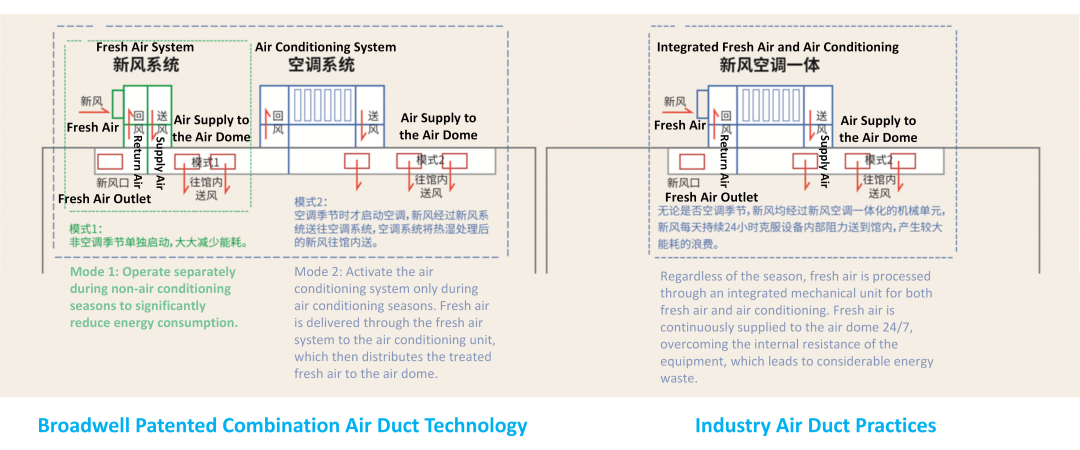
Building on cooling and insulation, Broadwell Air Dome further improves energy efficiency through a scientific air circulation design. Its independently developed patented combination air duct technology can precisely control the temperature of the air supply, preventing fogging and frosting issues within the architecture. More importantly, this technology significantly reduces energy consumption during non-operational periods by optimizing air circulation logic. There is no need for the equipment to run at full capacity during these times, achieving over 90% energy savings compared to conventional designs.
Conclusion
Broadwell Air Dome has created a comprehensive solution that optimizes core parameters of membrane materials, precisely matches supporting equipment and materials, and scientifically designs air circulation systems. This approach not only achieves a comfortable indoor temperature of 24–26°C in the extreme heat of the Middle East but also significantly reduces energy consumption, providing a viable model for the energy-efficient development of air domes in high-temperature regions.