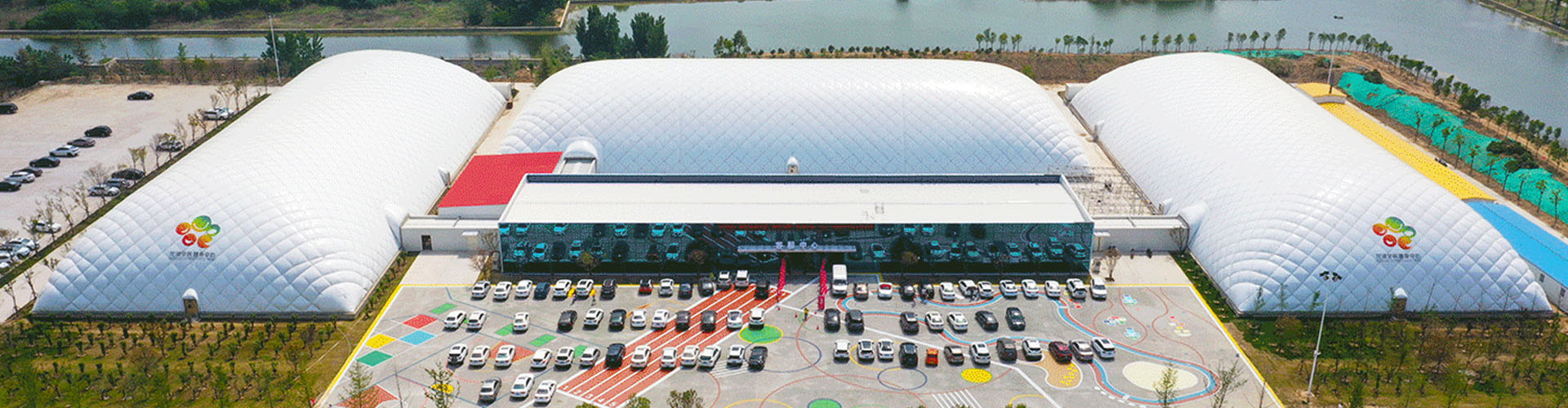
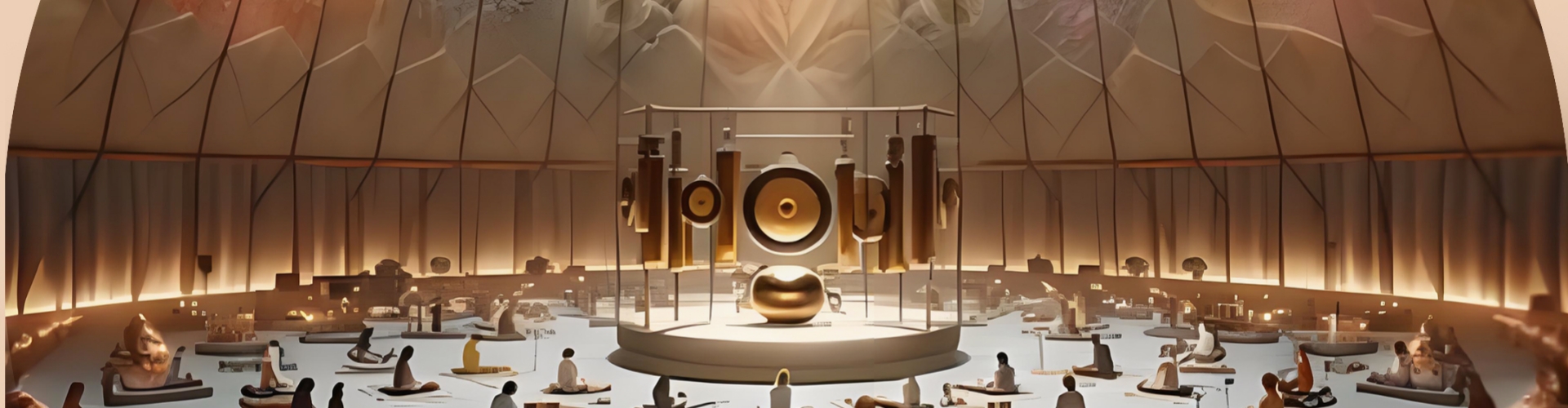
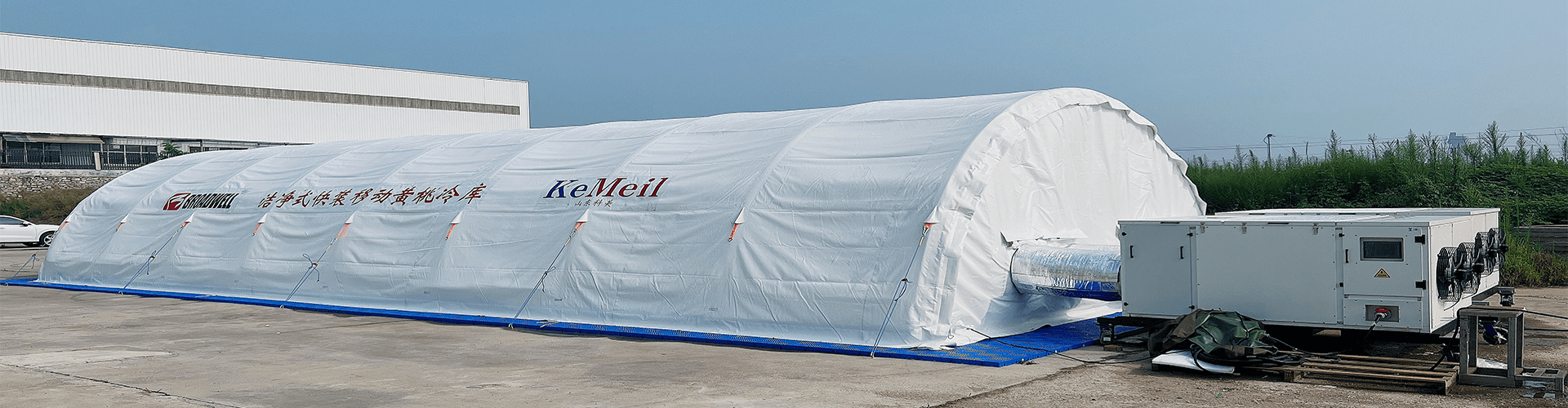
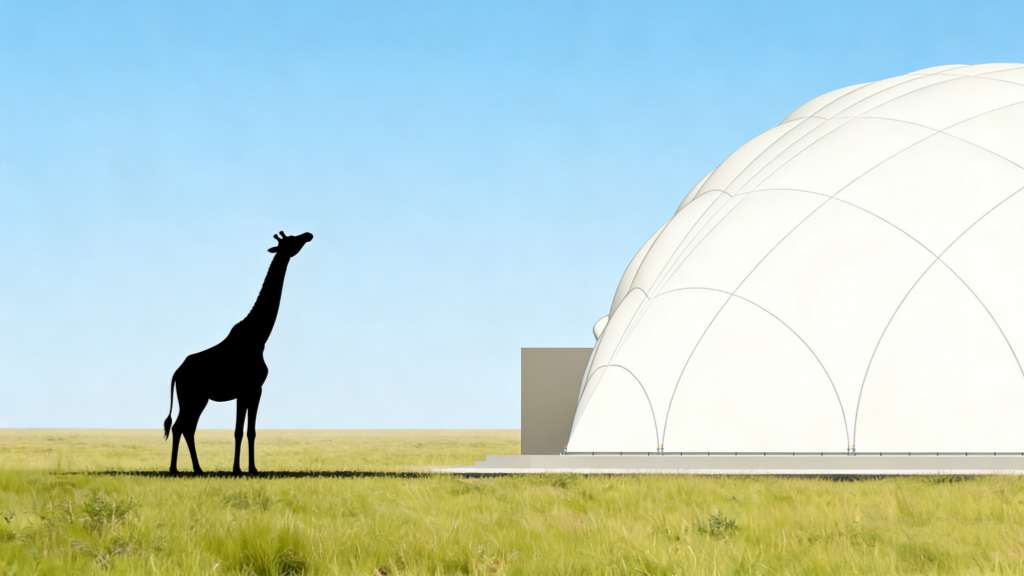
Air domes differ significantly from conventional steel or concrete buildings.
They rely on internal air pressure to inflate the membrane into an arched dome. From the highest point in the center toward both sides, the height gradually decreases, unlike flat-roof buildings, where the height is uniform across the entire span.
When owners first learn about air domes, one of the most common questions is:
“How tall should an air dome be to be considered appropriate?”
This article focuses specifically on height and explains the core logic behind height design for air domes.
1. Is There a “Standard Answer” for Air Dome Height?
To start with the conclusion:
There is no single fixed “standard” height, but there is a well-established, reasonable range.
In real-world projects, the industry widely follows this rule of thumb:
The peak height of an air dome is generally designed to be between 1/4 and 1/2 of its span.
Here, span refers to the clear width of the air dome in the transverse direction.
A simple example:
·When the span is 40 m, the height is typically designed in the range of about 10–20 m.
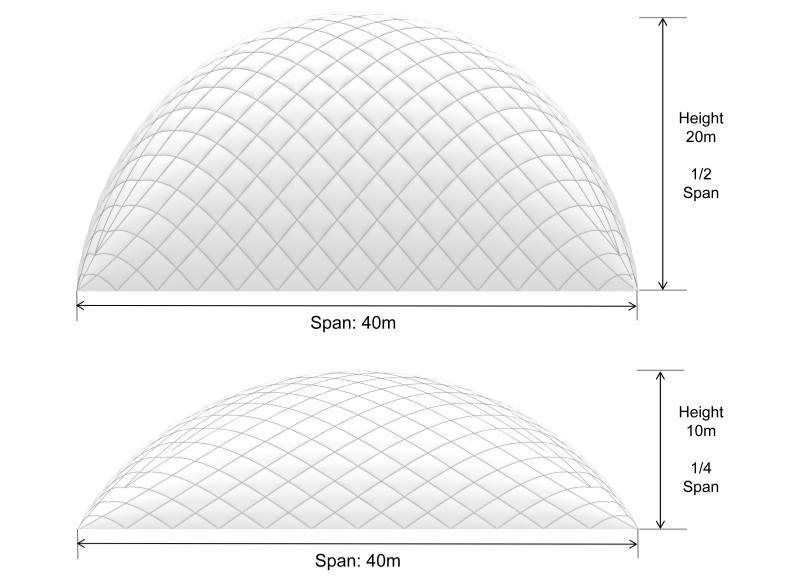
According to the book Technical Guide to the Design and Construction of Air-Supported Membrane Structures, the recommended height-to-span ratio ranges from 1/6 to 2/3. However, considering safety, architectural aesthetics, and user comfort in engineering practice, the 1/4–1/2 range is the “sweet spot” where the vast majority of projects end up.
2. The Higher the Better? Or the Lower the Safer?
Intuitively, many people think:
-
·“The higher it is, the more impressive and high-end it looks”; or
-
·“If we make it lower, it should be more stable and safer.”
In reality, neither of these views is entirely correct.
The height design for an air dome must strike a balance between three core factors:
-
·Architectural aesthetics
-
·User comfort (especially perceived clear height near the edges)
-
·Safety performance (with particular focus on wind and snow)
2.1 What Happens If the Height Is Too Great (Over 1/2 of the Span)?
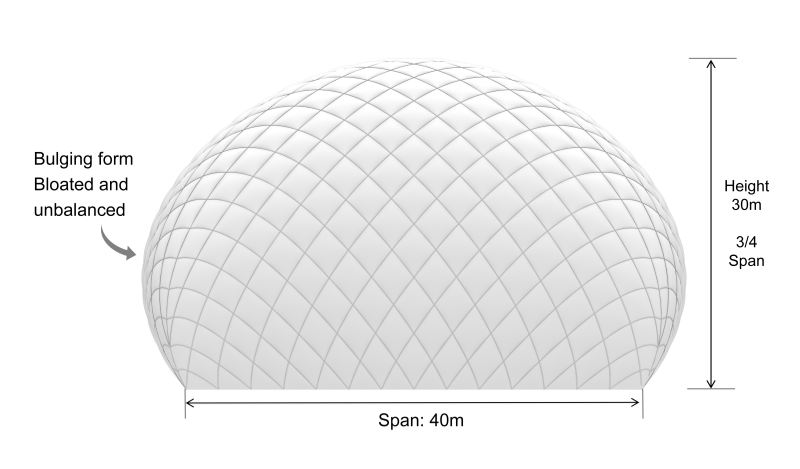
When the peak height of an air dome is greater than 1/2 of the span, several issues typically arise:
·Distorted proportions
The curvature becomes too large, and the edge areas near the ground look overly “bulged,” making the air dome appear bloated and visually unbalanced.
·Structurally inefficient
Excessive curvature changes how forces are distributed in the membrane. Higher internal pressure or a more robust anchoring system is often required to maintain shape, which is not economical from a structural design standpoint.
·Rarely used in practice
Considering overall form and structural efficiency, most projects will not design the dome height to exceed 1/2 of the span, unless there are very special functional requirements.
So, in real engineering practice, designing the height above 1/2 of the span is not a conventional choice.
2.2 What Happens If the Height Is Too Low (Less Than 1/4 of the Span)?
When the peak height is less than 1/4 of the span, another set of problems appears:
·Overly “flattened” profile
From the outside, the air dome looks extremely flat, lacking presence and a sense of volume.
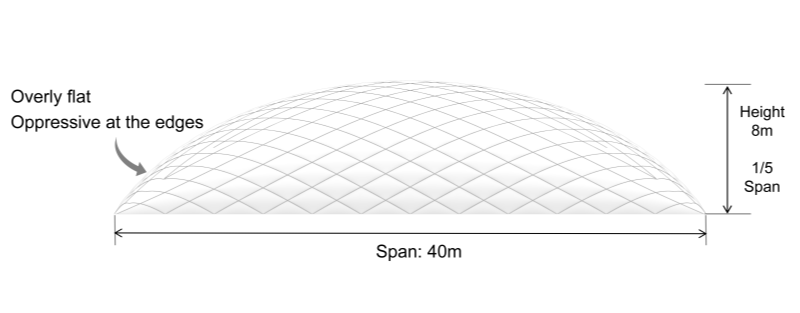
·Insufficient clear height at the edges, strong sense of oppression
An air dome is arched. From the center toward the edges, the height gradually decreases.
If the highest point is already quite low, the clear height in pedestrian zones near the sides will be noticeably insufficient, easily causing a sense of oppression and discomfort.
·Unable to meet height requirements for certain uses
For some sports, equipment layouts, or scenarios requiring a higher clear height, an overly low air dome may simply fail to meet basic functional requirements.
Therefore, overly low height is also not acceptable, as it harms user experience and limits functional adaptability.
3. In Different Climates, Should the Height Be Higher or Lower?
When determining height, another key external factor must be considered:
The climatic conditions of the project location, especially wind and snow, are important.
3.1 In Snowy Regions: Height Should Be Moderately Higher
In regions with heavy snowfall, if the air dome is too “flat” and the curvature too small, the membrane surface tends to form snow pockets. Snow does not slide off easily, and long-term accumulation significantly increases structural loads, potentially leading to collapse risks.
In such regions, designers usually:
-
·Increase the center height appropriately, giving the air dome a smoother slope.
-
·Use a larger curvature to help snow slide off naturally and avoid prolonged accumulation.
As a result, for projects in snowy regions, the height is often designed in the upper part of the 1/4–1/2 range, close to 1/2 of the span, balancing safety and overall form.
If the height is pressed too low, especially below 1/4 of the span, snow shedding becomes ineffective, which is not recommended from a structural safety perspective.
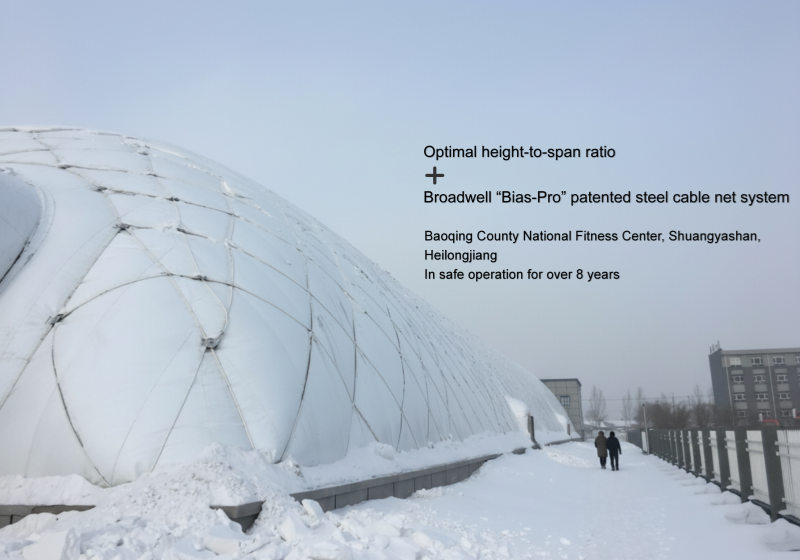
3.2 In High-Wind or Typhoon Regions: Height Should Be Moderately Lower
In regions with frequent strong winds or typhoons, the main concerns are:
-
·Wind pressure and suction acting on the membrane surface;
-
·The higher the air dome, the larger the windward area, and the more significant the wind load effects.
Therefore, in these regions, designers usually:
-
·Lower the center height appropriately, so the air dome sits more “hugging the ground”.
-
·Reduce wind impact on the structure and improve safety margins under extreme wind conditions.
-
However, if the height is too low, the architectural and comfort issues mentioned earlier will arise.
So typically, the height is still kept no lower than 1/4 of the span, and fine-tuned around or slightly above that ratio.
4. Why Must Height Design Be Handled by Professionals?
From the discussion above, it’s clear that the height of an air dome is not just about looking good. It is simultaneously influenced by:
-
·The span and overall plan dimensions
-
·The intended use (sports, warehousing, exhibitions, etc.)
-
·Local wind and snow conditions
-
·Structural behavior and shape stability requirements
-
·Architectural aesthetics and subjective spatial comfort
A professional air dome design team will, through form-finding analysis and related methods, and under the prerequisite of structural safety:
-
·Keep the height within a reasonable range of 1/4–1/2 of the span.
-
·Make targeted adjustments for different climates and uses.
-
·Ensure both overall proportions and aesthetics of the air dome, and a comfortable, clear height at the center and edges.
For owners, there is no need to decide on an exact height in meters by yourself.
What matters more is to clearly communicate your real needs:
-
·What is it used for? (type of sports, warehousing mode, etc.)
-
·Where will it be built? (local wind and snow conditions)
-
·Any particular preference for spatial feel? (more “grand and lofty,” or more “ground-hugging”)
Based on this, the design team—within the constraints of codes, standards, and structural calculations—will help you find that “just right” height that is safe, visually pleasing, and functionally practical.
From a safety standpoint, this is especially critical:
An air dome is a large-span space structure. If its height deviates from a reasonable range, its performance under extreme conditions, such as strong winds and heavy snow, can be directly affected.
Therefore, height design should never be a guess or a simple copy from another project.
It must be carried out and verified by an experienced professional air dome design team—this is not only responsible for the project itself, but also for the long-term safety of its users.